
Laurelhurst Fiber Art Studio & Urban Farm
Tablet Weaving * Ply-Splitting * Mindfulness * Permaculture
Tablet-Woven Rain Chain and Basin
by Linda Hendrickson and Rebecca Melton
created for the Collaborative Exhibition at Art in the Pearl, Portland, Oregon, 2006
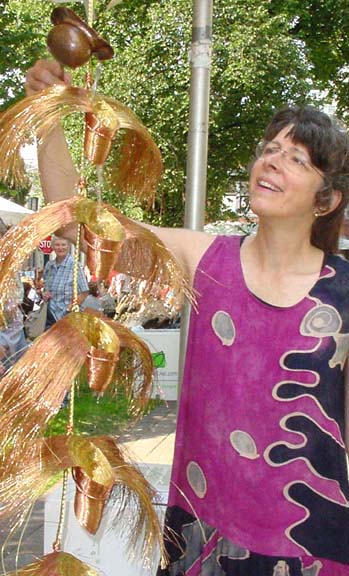
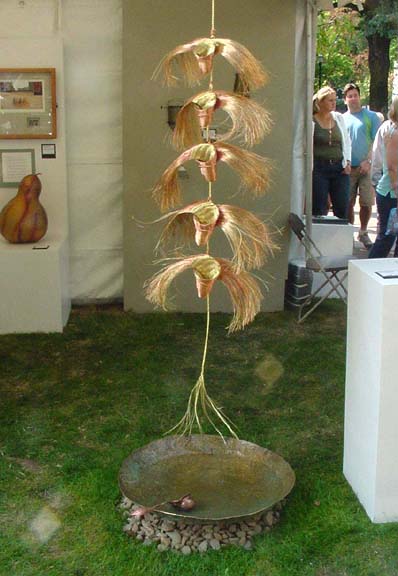
I was invited to participate in the collaborative exhibition at Art in the Pearl, held on Labor Day Weekend in the North Park Blocks in Portland. I decided to create a piece using tablet-woven copper and brass wire, and worked with Rebecca Melton, a metalsmith who recently received her MFA from the Oregon College of Art in Crafts.
Lately I have become interested in rain chains, especially the traditional Japanese style which consists of cups with open bottoms. Rebecca and I created a piece of garden art inspired by the rain chains -- Rebecca made a raised brass basin, and I made five tablet-woven cups using brass and copper wire. The cups were suspended from wire rope that I made with my Bradshaw cordmaker. Greg Wilbur provided a copper ladle for the basin, and people were invited to dip water from the basin and pour it into the cups.
I used the double-faced weave so one side is mostly brass and the other copper. Then by folding and shaping, I can get a pleasing funnel-shaped cup.
 We are lucky to have Alaskan Copper & Brass here in Portland, and I can go there and get the wire on one-pound spools. I wind a continuous warp directly from these spools by putting the spools on the horizontal dowels of my tensioning blocks and then up through a warping wand --- it works great. I make the warp around vertical posts, but instead of dropping the tablets on each side as usual, I lay each tablet on top of the previous one. Then when the warp is finished, I transfer it to my tensioning blocks with the horizontal dowels, and I'm ready to weave. My husband, John, recorded the processes of warping and weaving in DVD format when I demonstrated at the Silverton Fine Arts Festival earlier this month, and also recorded an interview of Rebecca explaining the process of raising and showing her working on the basin.
I experimented with different gauges of wire, number of tablets, and width and length of the woven section to see what works best. I used 22 and 24 gauge copper and brass and between 74 and 90 tablets. The heavier gauge was very difficult to weave, and the cup made from that weighs approximately 1.75 pounds!
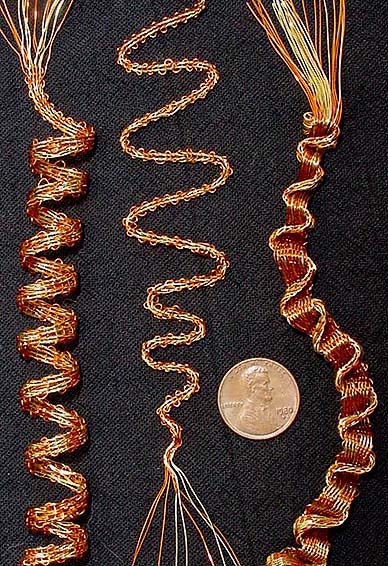
I demonstrated weaving with 28-gauge wire all three days at Art in the Pearl. The photo on the right shows samples that I made with brass in two holes and copper in two holes -- lots of great possibilities, and I'm looking forward to doing more tablet weaving with wire!
Left, Mostly warp twining with four tablets, then wrapped around a pencil to make the band coil.
Center, warp twining with just two tablets.
Right, warp twining and some double-faced weave with eight tablets, then two pieces folded repeatedly.
This page was created on September 13, 2006, and revised on April 7 2011.
Home